

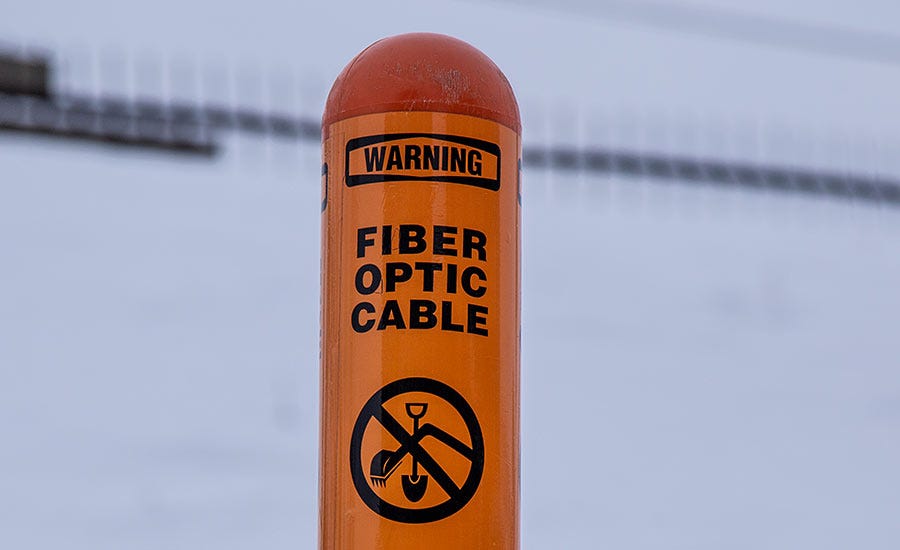
“Fiber cables only have one natural predator. The vicious and hungry backhoe.”
-Anonymous
What it actually costs to cut fiber
The bill for a fiber strike is rarely just the splice.
The average buried fiber repair commonly runs $5,000 to $15,000, and emergency buried restorations can reach up to $92,000. Those are repair numbers alone.
They don’t include the mobilization, traffic control, permits, and legal and liability exposure that stack on top, or the service interruption costs that telecom companies pass downstream to whoever cut the line. Claims usually take months to resolve, and insurance premiums increase accordingly.
The Common Ground Alliance found that the cost of a utility strike is over 29 times the explicit repair cost. When a fiber line goes, the consequences scale fast.
Fiber is invisible to most utility locating equipment
The average utility locator works by pushing an electrical signal down a buried line and tracing it from the surface. Copper carries that signal. Steel carries it. A locator can find a gas line or a water main because the line itself, or the metal in it, conducts.
Fiber optic cable is made of glass, and glass conducts nothing.
So fiber can only be located if someone buried a metal tracer wire alongside it. That wire is the entire locating strategy, and it is a single point of failure. It corrodes. It breaks. A previous dig severs it. Oftentimes, it is never put in at all. When there is no metallic tracer in the ground, the fiber is simply invisible to standard locating equipment. Roughly a third of telecom systems use fully non-metallic cable with no built-in way to find it later.
What a single cut can take down
In Logan, Utah, a construction firm was permitted to bore conduit under a city street for a nearby building project. The bore sliced through a major fiber bundle running down the street.
The result was not a localized outage. Broadband went dark across the entire county. Cellular towers in the area lost service, so residents lost mobile data on top of home internet. Local businesses lost days of work. One company at its headquarters described losing two days of wages and orders because the connectivity its operations depended on was simply gone.
That is the blast radius of a single bore through a single line nobody flagged. One crew, one pass, an entire region offline and a chain of businesses absorbing the loss. The contractor did the digging. The liability exposure followed the contractor.
This is the category of risk fiber represents. Not a nuisance repair, but a cut that can take a community offline and put your company at the center of it. Think about what that does to a contractor. You requested the locate. You got an official, documented response telling you the site was clear. You dug on it. And the cut, the repair bill, and the liability landed on you for trusting a mark the utility got wrong.
The penalties that fall on the utility provider for this kind of failure are real but small, often a few hundred to a couple thousand dollars per violation. The cost to the contractor who dug in good faith is a different order of magnitude entirely. That asymmetry is the quiet truth of fiber strikes. The large corporate giant that created the error pays the least, and the contractor that relied on the erroneous markings pays the most.
Stop trusting the mark. Know the ground.
SubVysion delivers a verified picture of what is actually beneath your site, one that does not hinge on whether a thirty-year-old tracer wire survived, or whether a contract locator typed “all clear” on a site that wasn’t. We use ground-penetrating radar, capable of detecting both metallic and non-metallic lines. You see the fiber, the conflicts, and the surprises while they are still on a screen, where a change costs hours instead of a five-figure repair and a region-wide outage.
With fiber, what you can’t see is what bills you. Know what is under the ground before you commit to digging it.
Frequently asked questions
Why can’t fiber optic cable be located like other utilities? Fiber is made of glass, which conducts no electrical signal. Standard locators work by tracing a current along a conductive line, so fiber can only be found if a metal tracer wire was buried alongside it. If that wire is missing, broken, or corroded, the fiber is invisible to normal locating equipment.
Does calling 811 guarantee fiber will be marked? No. A “marked” or “clear” response can be wrong, which is why 811 centers tell excavators to verify that marks on the ground match the ticket. Private fiber and non-member lines may not be marked by anyone.
How much does it cost to repair a cut fiber optic cable? Buried fiber repairs commonly run $5,000 to $15,000, with emergency restorations reaching $25,000 and severe telecom-facility damage reported as high as roughly $92,000. Mobilization, permits, traffic control, legal exposure, insurance premiums, and fines are additional.
Who pays when a contractor cuts a fiber line? Often the contractor, even when the locate was wrong. Penalties on a utility for a bad or missing locate are typically small, while the contractor who relied on that locate can face the full repair cost, escalating fines, and liability for the resulting outage.